
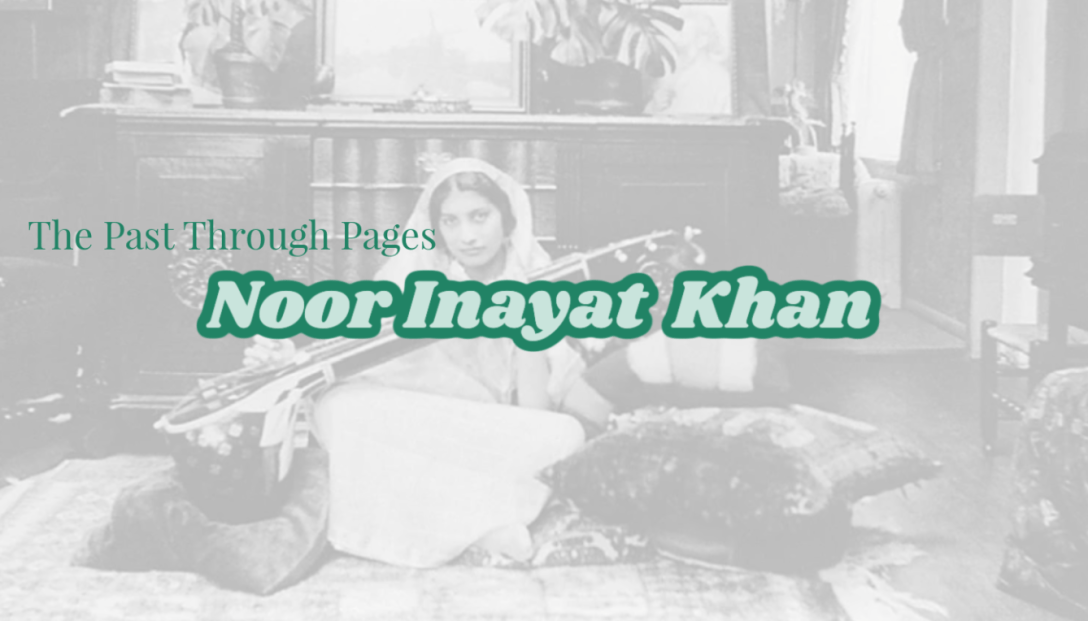
Rather than analysing a book about a certain historical story like the other posts in this series, this post draws inspiration from a podcast I recently listened to. The podcast about the life and espionage work of Noor Inayat Khan, a female British-Indian SOE agent during WWII, sparked my interest in her story.

‘The Spy Who Wouldn’t Lie’, Wondery (⭐️⭐️⭐️⭐️⭐️/5)
I liked how the podcast series emphasised Khan’s background, as her upbringing in a peaceful environment by a Sufi mystic contrasts with the fact that she became one of the most significant radio operators in Nazi-occupied France. The series also highlights the key events in her time as an agent, her successes, the risks she faced and the sacrifice she made after being captured by the Gestapo. The podcast described her initial struggles during SOE training extremely well and explored the huge psychological pressure Khan would have faced in detail.
Background
Noor Inayat Khan was born in Moscow in 1914 to an Indian Sufi mystic father and an American mother. She was raised in France, attending the Sorbonne and becoming an accomplished musician, writing children’s books and composing music. However, when the Nazis invaded France in 1940, Noor’s family fled to Britain, where she chose an unlikely path, espionage.
Despite her pacifist upbringing, Khan joined the Women’s Auxiliary Air Force and then the Special Operations Executive (SOE), a clandestine British agency set up to assist resistance movements in Nazi-occupied Europe. She initially struggled during her SOE training, having difficulty with weapons handling and blending in during field exercises, but her determination to succeed helped her pass her training. As one of the first female wireless operators sent into France, Khan knew that the stakes were high, as wireless messages were being intercepted with alarming frequency, but she remained committed.
Her dedication to the Allied cause despite her nonviolent principles impressed me. She was raised with the values of peace and nonviolence by her father, but she still chose to risk her life to protest against tyranny.
Work in Paris
In June 1943, Khan flew into France under the code name “Madeleine.” Soon after her arrival, the Gestapo arrested many of her fellow agents, leaving her as the last wireless operator in Paris. Against all odds, she managed to carry out her mission unassisted for three months, sending crucial intelligence to London.
A radio operator in occupied France had a six-week survivability rate, but Khan fought that probability, constantly moving locations to avoid capture and refusing to abandon her work. The mental strain and demands of constant vigilance were immense, and she conducted her work under so much pressure, knowing that every transmission could lead to her exposure.
Betrayal, Capture and Execution
Khan’s courage and skill of going undetected could not shield her from betrayal. She was turned in by a double agent, and the Gestapo made her arrest in October 1943. All through her captivity, she remained firm and attempted many escapes, refusing to reveal any information under brutal interrogation. Frustrated at her defiance, the Nazis labeled her “highly dangerous” and transferred her, in September 1944, to the Dachau concentration camp.
Noor Inayat Khan was executed in Dachau on September 13, 1944, with her last word reportedly to have been “Liberté.” She was posthumously awarded the George Cross and the French Croix de Guerre, but for decades her story remained overshadowed.
What does her story tell us about the role of women in espionage?
Khan’s role as an SOE agent fitted into a broader change in society, which saw women included in different activities during WWII. Unlike in WWI, where women were rarely considered for roles, especially ones in espionage. The SOE intentionally recruited more women because they moved more easily in the occupied territories and raised fewer suspicions. Khan, alongside other female operatives like Odette Sansom and Violette Szabo, proved that women could be just as effective, if not even more so, than men in clandestine operations. Their bravery helped redefine gender roles in the military and intelligence, allowing for greater female contributions in the future.
Reflections
Khan’s story has raised many intriguing questions for me about the broader role of women in the SOE. For example, how do Khan’s experiences compare to those of other female spies of the era and what long-term impact did her achievements have on British espionage? Exploring these questions could prove to be very interesting and would provide an insight into the legacy of women in intelligence.
Today, Noor Inayat Khan’s legacy stands as a symbol of courage and sacrifice. Her statue in London’s Gordon Square ensures that her contributions will not be forgotten. I believe this inspiring story of bravery and defiance of stereotypes, along with the stories of all other female agents during WWII, still deserve more attention.

 telling tales